
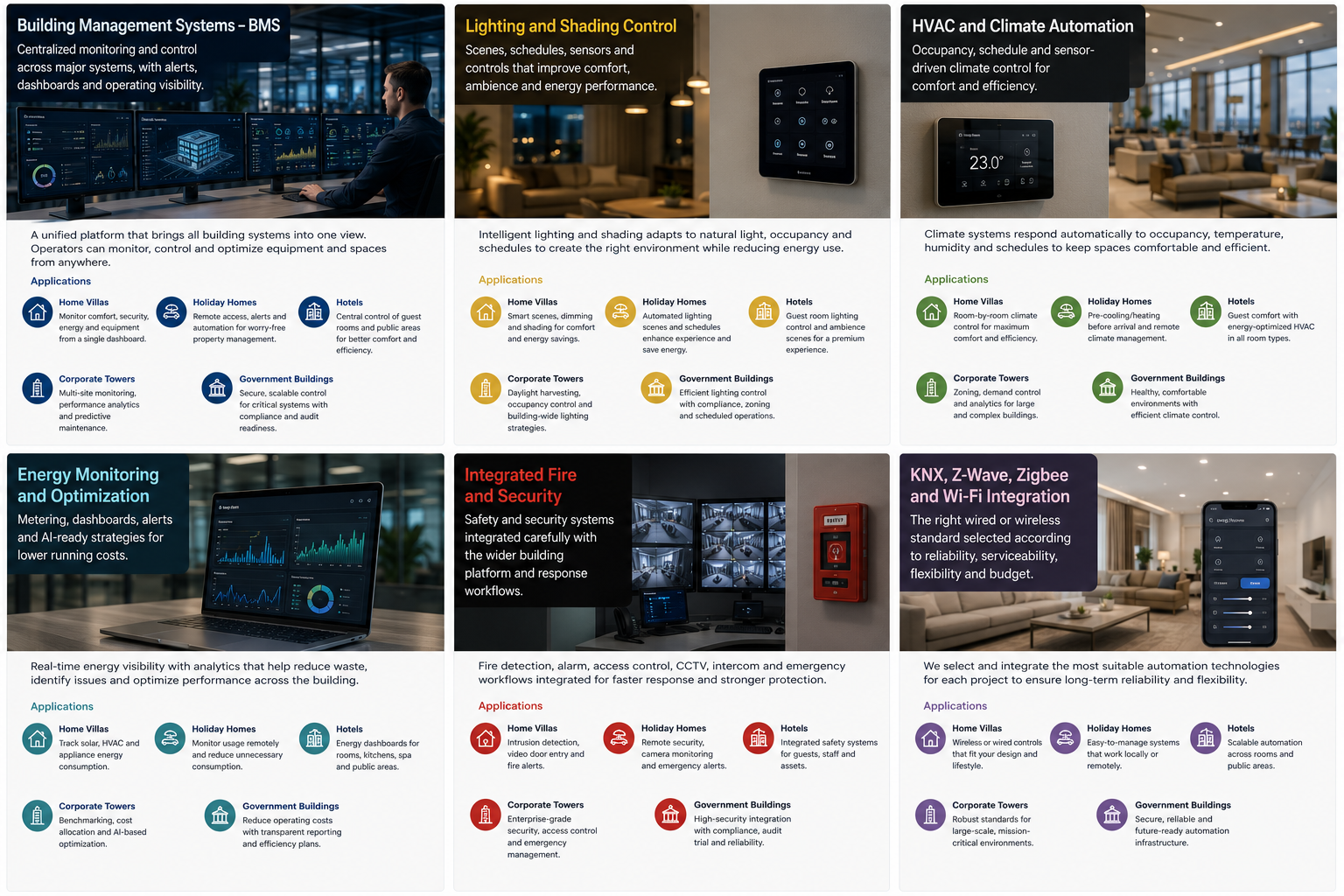
A Building Management System is the central control layer that connects and monitors the major systems inside a building. Greenology designs BMS platforms that bring HVAC, lighting, energy meters, pumps, chillers, electrical panels, fire interfaces, security systems and other building equipment into one operational environment.
Instead of managing every system separately, the BMS gives facility teams a unified dashboard where they can monitor performance, receive alerts, review system status, adjust schedules, analyse energy use and respond to faults faster. This improves day-to-day operation and gives owners better visibility over how the building is performing.
Greenology’s BMS approach focuses on practical operation, not only technical integration. We consider how facility teams will use the system, what alarms matter, what data should be displayed, what reports are needed and how the platform should support maintenance, comfort, energy efficiency and compliance.
Applications include:
Home villas and luxury residences: central control of comfort, lighting, energy, security and climate.
Holiday homes: remote monitoring, alerts, energy control and occupancy-based operation.
Hotels and resorts: guest-room comfort, public-area control, energy optimisation and engineering-team visibility.
Corporate and commercial towers: multi-floor monitoring, tenant-area control, central plant visibility and maintenance planning.
Government and public-sector buildings: reliable control, audit readiness, operational reporting and secure system access.
Key benefits:
Centralised monitoring and control
Faster alarm response
Better operating visibility
Improved comfort and energy performance
Easier maintenance and reporting
Scalable platform for single buildings or large estates
Smart-building performance depends on selecting the right automation standard for the project. Greenology designs integration using wired and wireless technologies such as KNX, Z-Wave, Zigbee, Wi-Fi and IP-based systems depending on reliability, serviceability, flexibility, budget and building type.
KNX is often preferred for robust wired automation in villas, hotels, commercial buildings and high-reliability environments. Z-Wave and Zigbee can be suitable for flexible wireless control, retrofit projects or specific device ecosystems. Wi-Fi and IP-based systems support connected devices, cloud applications, mobile control and integration with modern platforms.
Greenology does not treat technology selection as one-size-fits-all. We assess the building layout, construction stage, system criticality, maintenance model, user expectations, future expansion and integration requirements before recommending the best architecture.
Applications include:
Home villas: KNX or hybrid automation for lighting, shading, HVAC, scenes, security and energy.
Holiday homes: remote access, wireless integration, smart locks, climate control and energy-saving modes.
Hotels: guest-room automation, lighting scenes, HVAC, shading and central monitoring.
Corporate towers: IP-based integration, BMS interfaces, meeting-room automation and energy control.
Retail and hospitality: ambience control, lighting scenes, background systems and flexible control.
Government buildings: reliable wired infrastructure, secure control and long-term serviceability.
Key benefits:
Right technology selected for the project
Reliable wired and wireless integration
Better serviceability and future expansion
Flexible control across rooms and systems
Integration with BMS, ELV, ICT and security
Cost-effective design aligned with performance needs
Lighting and shading control improves comfort, ambience, energy performance and user experience by automating how light enters and operates inside the building. Greenology designs lighting and shading systems using scenes, schedules, occupancy sensors, daylight sensors, touch panels, mobile controls and automation logic.
The system can create different lighting moods for daily use, meetings, hospitality spaces, retail environments, bedrooms, lobbies, restaurants, offices and public areas. Shading can be controlled automatically based on sunlight, heat gain, privacy needs, time of day or user preference.
This helps reduce unnecessary energy use while improving the quality of the indoor environment. In premium spaces, lighting and shading also play an important role in the visual identity of the building, creating the right atmosphere for guests, residents, staff or customers.
Applications include:
Home villas: smart lighting scenes for living, dining, cinema, bedrooms, outdoor areas and security.
Holiday homes: automated lighting and shading for comfort, privacy, energy saving and remote control.
Hotels: guest-room scenes, lobby ambience, restaurant mood lighting, corridor schedules and energy-saving controls.
Corporate towers: occupancy-based lighting, daylight harvesting, meeting-room scenes and after-hours energy saving.
Retail and luxury spaces: brand-focused lighting, display control, ambience and customer-experience enhancement.
Government buildings: efficient lighting schedules, zoning, security lighting and public-area control.
Key benefits:
Better comfort and ambience
Lower lighting energy consumption
Automated daylight and occupancy response
Premium user experience
Flexible scenes and schedules
Integration with BMS, security and room controls
HVAC and climate automation allows the building to control heating, cooling, ventilation and indoor comfort more intelligently. Greenology designs climate-control systems based on occupancy, schedules, temperature sensors, humidity sensors, air-quality sensors, room usage and energy-performance requirements.
Instead of running HVAC systems continuously or manually, automation helps the building respond to real conditions. Rooms can be cooled before arrival, reduced when vacant, adjusted by zone, controlled by guest preference or optimised based on operating schedules.
For larger buildings, HVAC automation can connect with chillers, AHUs, FCUs, VAV boxes, pumps, ventilation systems and BMS dashboards. This gives facility teams better control over comfort, energy use and equipment performance.
Applications include:
Home villas: room-by-room climate control, energy-saving schedules and comfort scenes.
Holiday homes: remote pre-cooling/pre-heating, humidity protection and vacant-mode energy saving.
Hotels: guest-room HVAC automation, occupancy-based comfort, corridor control and public-area optimisation.
Corporate towers: zone-based control, meeting-room climate, tenant schedules and central plant optimisation.
Healthcare and laboratories: controlled climate, ventilation monitoring and operational reliability.
Government buildings: efficient HVAC scheduling, operating visibility and centralised control for large facilities.
Key benefits:
Improved occupant comfort
Lower cooling and heating costs
Occupancy-based energy savings
Better air-quality and humidity control
Reduced equipment stress
Integration with BMS, sensors and energy dashboards
Energy monitoring and optimisation gives owners and operators clear visibility into how energy is being consumed across the building. Greenology integrates meters, dashboards, alerts and control strategies to help identify waste, reduce operating costs and support sustainability goals.
The system can monitor electricity, lighting loads, HVAC consumption, plug loads, tenant areas, common areas, plant rooms, renewable generation, EV charging and other major energy users. By collecting real-time and historical data, operators can understand consumption patterns, detect abnormal usage and take corrective action.
Greenology also designs AI-ready energy strategies where data can support forecasting, predictive maintenance, automated optimisation and ESG reporting. The goal is to move from simple metering to active energy management.
Applications include:
Home villas: visibility on energy use by system, room or appliance category.
Holiday homes: remote energy tracking, abnormal consumption alerts and vacant-mode optimisation.
Hotels: room energy monitoring, kitchen/spa/public-area tracking and cost control across operating zones.
Corporate towers: tenant metering, common-area optimisation, benchmarking and reporting.
Industrial and mixed-use facilities: monitoring of equipment, production loads and operational energy performance.
Government buildings: transparent energy reporting, efficiency planning and sustainability compliance support.
Key benefits:
Lower running costs
Better energy visibility
Abnormal consumption alerts
Improved sustainability reporting
Support for ESG and certification goals
AI-ready optimisation and predictive maintenance
Integrated fire and security connects safety and security systems carefully with the wider building platform and operational workflows. Greenology coordinates fire alarm interfaces, access control, CCTV, intrusion detection, emergency communication, public address, door release logic and BMS integration where appropriate.
The purpose is not to compromise safety systems, but to ensure the right information and response actions are available when an event occurs. For example, a fire alarm event can trigger visibility on the BMS, release selected doors, activate emergency workflows, support evacuation announcements and help operators understand the affected zone.
Security systems can also be linked with building automation to improve response, monitoring and reporting. This includes access events, intrusion alerts, CCTV verification, intercom calls, visitor management and security dashboards.
Applications include:
Home villas: intrusion alerts, CCTV, intercom, access control and safety notifications.
Holiday homes: remote security visibility, alarm alerts, camera verification and emergency notification.
Hotels: guest safety, staff response workflows, access control, CCTV and emergency communication.
Corporate towers: access zones, CCTV integration, fire alarm visibility and command-room support.
Government buildings: higher-security workflows, controlled access, audit logs and integrated response.
Campuses and multi-building estates: centralised monitoring, event verification and coordinated response.
Key benefits:
Faster event verification
Better safety and security coordination
Integrated response workflows
Improved operator visibility
Stronger protection of people and assets
Better reporting and audit readiness
 Talk To us